
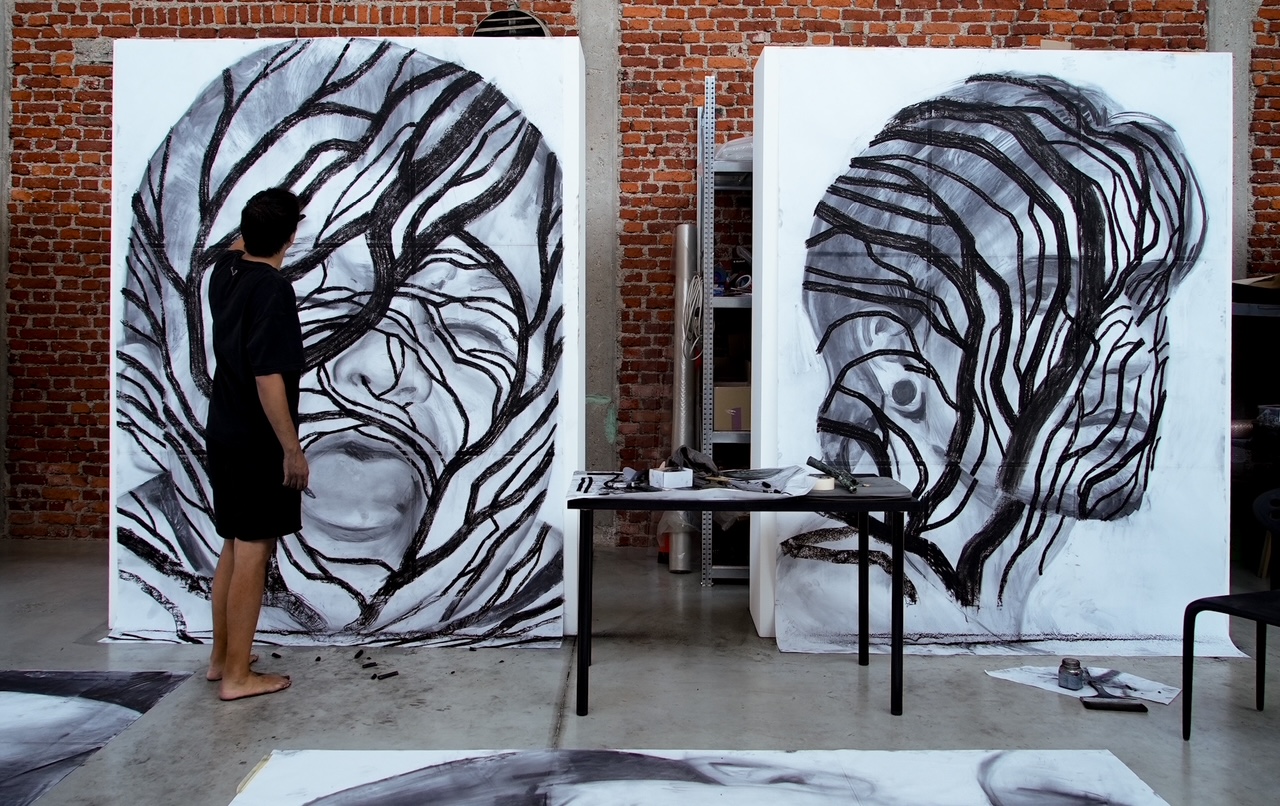
Thirty-six self-portraits, spanning the years 1990 to 2026, come together as an installation conceived as a single organism. For the first time, Egeon presents a previously unseen body of charcoal drawings, marking the introduction of a medium only recently incorporated into the artist’s practice. Derived from photographs taken by different individuals, the portraits evoke a constellation of unstable memories. Like memory itself, the charcoal mark is inherently fragile and impermanent: subject to the passage of time, it may fade, shift, or disappear altogether.
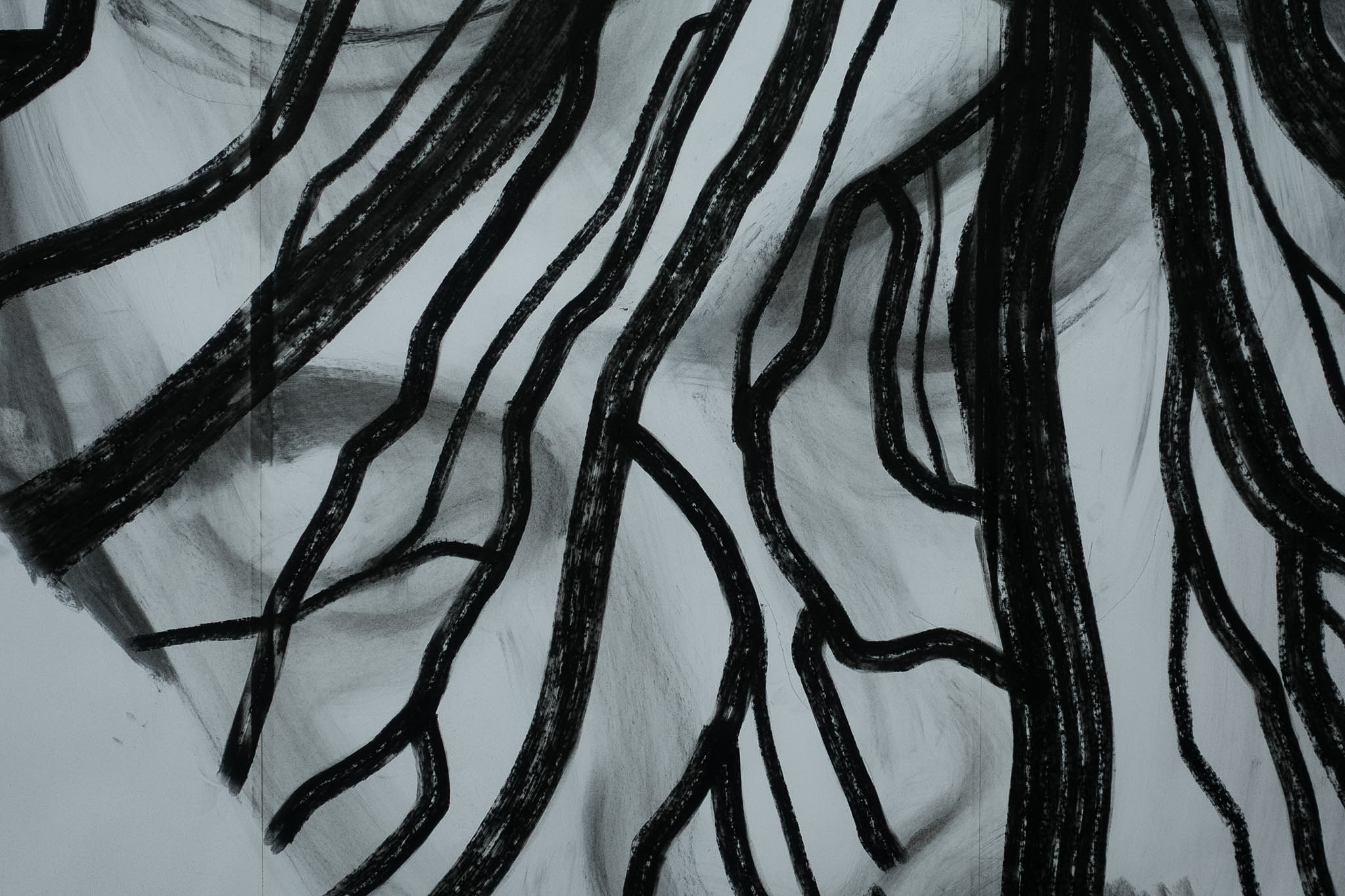
Each face is traversed by a network inspired by the rhizomorphs of the Armillaria fungus—filamentous, parasitic structures that spread through trees, accelerating their decay. Yet while they accompany the death of their host, they also sustain the regeneration of the forest by enabling the recycling of nutrients. Charcoal, produced from wood, and paper, derived from cellulose, both point back to the forest as the material origin of the work.
The installation recalls this ecosystem through large suspended portraits that are free to rotate, continuously reconfiguring their relationship with one another and with the viewer.
Each face is traversed by a network inspired by the rhizomorphs of the Armillaria fungus—filamentous, parasitic structures that spread through trees, accelerating their decay. Yet while they accompany the death of their host, they also sustain the regeneration of the forest by enabling the recycling of nutrients. Charcoal, produced from wood, and paper, derived from cellulose, both point back to the forest as the material origin of the work.
The installation recalls this ecosystem through large suspended portraits that are free to rotate, continuously reconfiguring their relationship with one another and with the viewer.
For the occasion, Egeon will also create a temporary mural depicting a cluster of Armillaria rhizomorphs on SAC’s main façade, conceived as an extension of the installation into the exterior space.
Sofia De Pascali
Artist biography
Egeon (Bolzano, 1990) is an artist who works in public spaces, where muralism and installation are the mediums through which he explores the relationship between image, place, and memory. His work stems from his engagement with the contexts in which he intervenes, transforming walls, architecture, and landscapes into canvases for visual inquiry.
His research navigates the intersection of human interactions and the processes of memory, exploring the cognitive and affective maps that guide the mind and help define our perception of reality. In recent years, his visual language has increasingly rooted itself in the imagery of the forest: an ecosystem inhabited by plants, animals, and fungi, where invisible relationships generate symbols and archetypes.
In an organic dialogue between the human and the natural, her gaze upon nature moves between scientific observation and poetic intuition. From this tension emerges an essential visual language, marked by a raw melancholy, which, without rhetoric, observes humanity’s paradoxical behavior in the face of life, poised between ugliness and wonder.
His research navigates the intersection of human interactions and the processes of memory, exploring the cognitive and affective maps that guide the mind and help define our perception of reality. In recent years, his visual language has increasingly rooted itself in the imagery of the forest: an ecosystem inhabited by plants, animals, and fungi, where invisible relationships generate symbols and archetypes.
In an organic dialogue between the human and the natural, her gaze upon nature moves between scientific observation and poetic intuition. From this tension emerges an essential visual language, marked by a raw melancholy, which, without rhetoric, observes humanity’s paradoxical behavior in the face of life, poised between ugliness and wonder.
© Davide Menegazzi